


Private Markets Research Capabilities
Our Private Markets Research team has over 40 years of collective experience in private markets investments and is a pioneer in providing private markets access and democratization.
As active managers, we have allocated more than $3 billion to private market managers over the past two decades, conducted hundreds of due diligence and research meetings and established relationships with leadership and portfolio teams at many of the largest global private market asset managers across private equity, venture capital, private credit, infrastructure and real estate. During this time, we have continually refined our rigorous private markets due diligence process.
Our experience predates much of the recent “democratization” efforts in private markets. Our team pioneered access to listed private equity with the creation of the Global Listed Private Equity (GLPE) Index in 2007, the first ’40 Act-compliant private equity index, which enabled broad access to an asset class that historically presented high barriers to entry due to investor qualification requirements, long lock-up periods and significant minimum investment thresholds.
Private Markets Due Diligence Approach
Allocating to private markets is fundamentally different from investing in public markets. Our evaluation approach reflects decades of experience in research, due diligence, capital allocations and direct investment.
-
Our framework leverages public and private markets research methods to identify suitable private market allocation candidates for clients who seek enhancements in risk-adjusted investment outcomes.
-
Our research focuses on semiliquid, closed-end fund structures, including interval funds, tender offer funds, non-traded Business Development Companies (BDCs) and non-traded Real Estate Investment Trusts (REITs).
Objective
Our objective is to help clients understand private market strategies, structures, risks, benefits and limitations to empower informed allocation decisions and achieve desired investment outcomes.
Diligence Approach
Private markets research and due diligence differ significantly from public markets. Key issues include limited data transparency, reporting lags, smoothed performance returns and wide dispersions of outcomes, all of which must be considered alongside traditional due diligence factors. Below are some of the most important distinctions between private and public markets.
| Private vs. Public Market Diligence Considerations |
||
| Private Markets | Public Markets | |
| Research | Limited transparency: research often requires direct communication, operational due diligence and specialized resources; less transparency due to limited disclosure requirements. Data for evergreen funds is emerging and improving but not fully sufficient for informed decisions. | High transparency with broad access to public disclosures (10-Ks, earnings calls); analyst coverage, and standardized reporting. |
| Performance | Smoothed quarterly returns may mask correlations, volatility and drawdowns. Often measured using money-weighted returns (IRR, MOIC, DPI); cash flow timing significantly impacts returns. Rule ASC 820 can distort returns for secondary transactions. | Measured using time-weighted returns (TWR); marked to market daily with consistent benchmarks. Correlations reflect liquidity and price movements. |
| Dispersion of Returns | High dispersion within peer groups, with potential material impacts from underperformance with limited reallocation options. | Narrow dispersion among peer groups; high degree of optionality to reallocate and rebalance positions. |
| Portfolio Rebalancing | Illiquidity requires upfront diversification and longer investment horizons, with denominator effect concerns. Evergreen funds offer limited liquidity (e.g., 5% redemptions per quarter) but may not fully support investor objectives. | Highly liquid and easily rebalanced; allocations can be adjusted rapidly. |
| Liquidity | Highly illiquid, emerging semi-liquid vehicles provide more access, but core assets remain illiquid. Requires robust liquidity management, scenario analysis and governance to meet commitments and optimize returns. | Highly liquid with daily trading; deep and transparent secondary markets enable tactical allocation, risk management and portfolio rebalancing. |
| Valuations | Infrequent, subjective and often event-driven; based on fundamentals and negotiation, with limited transparency. | Continuous price discovery and daily mark-to-market; driven by public sentiment, transparency and macro factors; valuations rapidly reflect new information. |
| Data Transparency | Fund and portfolio data often provided with little to no context or transparency on the underlying fund positions and characteristics (manager, vintage, sector, company) | Generally, fully transparent disclosures in holdings and positions. |
| Adverse Selection | Higher risk due to information asymmetry, limited transparency and complex deal structures; managers may have superior asset knowledge. | Lower risk due to broad disclosure, regulatory oversight and analyst coverage, though information asymmetry can still arise around new issues, complex securities, or during periods of market stress. |
| Optionality | Limited flexibility from negotiation over terms and secondary sales; post-commitment flexibility is constrained. Evergreen funds offer limited optionality (e.g., quarterly redemptions) but may not fully support all objectives. | High flexibility: investors can buy, sell, or adjust allocations at any time; deep public markets enable ongoing strategic management. |
|
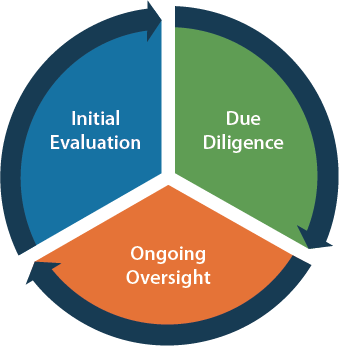
Private Markets Due Diligence Process |
Initial Evaluation
Allocators to private markets seek exposure to the following asset categories:
Private Equity
Private Equity consists of long-term investments in privately held companies by way of buyouts or growth capital, focusing on value creation through operational improvements or strategic repositioning; characterized by illiquidity, long lock-up periods and potential for high risk-adjusted returns.
Venture Capital
Venture Capital targets early-stage, high-growth companies (typically technology and emerging sectors) for equity investments; performance is characterized by a small number of outsized successes.
Private Credit
Private Credit refers to non-bank, direct lending to companies, as well as other forms of lending including asset-based (or cash flow), special situations (or opportunistic) and distressed. It encompasses lending and investing in all parts of a company’s capital structure, including secured and unsecured senior debt, mezzanine and structured credit. These investments offer enhanced yields and flexible structuring but come with illiquidity and heightened borrower-specific risks compared to public fixed income.
Private Infrastructure
Private Infrastructure consists of equity or debt positions in essential, long-lived assets such as utilities, transportation and energy systems, seeking stable, inflation-linked cash flows and lower correlation to traditional markets but facing regulatory and project risks.
Private Real Estate
Private Real Estate involves direct or fund-based investments in commercial, residential and industrial property using core, value-add, or opportunistic strategies; income and appreciation depend on market cycles, property management and financing, balanced by sector-specific risks and illiquidity.
For initial evaluation, funds are screened for: length of track record, fund size, investment objective, performance, manager breadth and history. Criteria includes:
- Minimum $250M in assets.
- History of consistent asset growth and inflows.
- Top quartile performance.
- Demonstrated breadth and track record across other fund structures.
Due Diligence
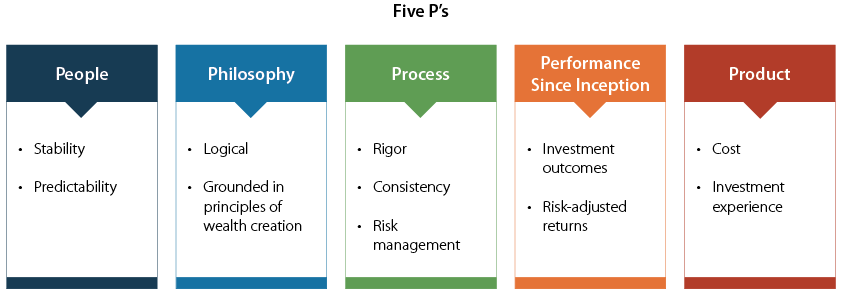
Once an initial list is created, we collect due diligence questionnaires from fund managers and apply our “Five P’s” evaluation framework. We often hold direct discussions with manager portfolio teams to understand their strategy, portfolio construction, return drivers and risk management.
Additional Considerations for Private Markets Funds
In addition to traditional due diligence considerations, we look in depth at the following categories and considerations to better understand fund operations, drivers of returns, risks and potential distribution of investment outcomes that are unique to private markets funds as well as attributes and characteristics native to their respective categories (Private Equity, Venture Capital, Private Credit, Private Infrastructure, Private Real Estate).
| Additional Considerations for Private Markets Funds | ||
| Category | Considerations | |
| Fund Structure | Assess interval vs. tender-offer features, repurchase mechanics, registration compliance, structural elements (e.g., side pockets, leverage limits), NAV methodology, secondary market alternatives, transparency on redemptions, legal documentation, audited statements and third-party providers. | |
| Manager & Team | Review manager private markets track record, experience with interval/tender funds, team depth, governance policy, independent oversight presence, succession planning, key-person clauses, staff turnover and alignment of interests. | |
| Deal Flow & Sourcing | Analyze manager’s historical/projected deal flow, direct sourcing, co-invest/secondary opportunities, pipeline visibility and infrastructure for due diligence/investment execution and monitoring. | |
| Deal Underwriting | Assess approach to risk, expected returns, structural fit, thorough due diligence, alignment of interests, investment thesis, risk and operational/legal safeguards. | |
| Portfolio Construction | Understand asset selection, investment mix, restrictions, concentration limits, diversification mandates, opt-in/out features and fund vintage considerations. | |
| Manager Scale & Capacity | Review manager’s other funds and structures, AUM, operational scale, resources, technology, capital deployment ability, auditor/administrator relationships, and compliance support. | |
| Risk Management | Consider sector-specific, geographic, vintage year risks, diversification across positions/managers/sectors/geographies, intentional versus unintentional bets and level of control over outcomes. | |
| Valuation Philosophy and Approach | Evaluate valuation policy, frequency, use of third-party appraisers and consistency across other funds and managers. | |
| Fees and Expenses | Identify management, performance/incentive, distribution, leverage/financing, repurchase and administrative expenses; assess fee layering, benchmarking, caps, waterfall structures and transparency. | |
| Investor Qualification and Considerations | Assess investor accreditation, restrictions, tax treatment and Regulated Investment Company (RIC) compliance. | |
Quantitative Considerations for Private Markets Performance
The Importance of Desmoothing Returns
Private market funds often report smoothed returns due to appraisal-based asset valuations, quarterly pricing and managerial discretion over marks—resulting in artificially low volatility and autocorrelation. Desmoothing involves statistical techniques to reverse-engineer reported return series by regressing against a public market proxy and incorporating appropriate lag periods. Desmoothed returns yield a more realistic picture of risk, often increasing calculated volatility, reducing autocorrelation and clarifying correlations and beta exposures vs. public markets.
For allocators, using desmoothed data can materially affect portfolio construction, expected drawdowns and the perceived diversification benefits of private market allocations. Desmoothing is particularly important for policy committees and risk teams seeking to understand stress scenarios and the true drivers of performance during public market corrections. While desmoothing introduces complexity, it is vital for accurate benchmarking, capital allocation and understanding the underlying economics—especially when comparing interval and tender-offer funds to daily-valued public vehicles.
In addition to desmoothing returns, we look at the following quantitative characteristics to better assess the return profiles vs public counterparts.
| Characteristic | Quantitative Considerations | |
| Returns | Review annualized returns across periods (1, 3, 5, 10 years). Desmooth and compare against public equivalents, and measure performance relative to private market/public benchmarks such as the S&P 500 Index, Bloomberg US Aggregate Bond Index and sector indices. | |
| Attribution | Analyze portfolio drivers, assess positive/negative contributors, deal flow strength, positions and overall contributions. | |
| Impact of Rule ASC 820 on Returns | Consider performance distortion from discount mark-ups when funds acquire assets via secondary market; separate discount mark-ups from NAV growth for a better understanding of performance drivers. | |
| Drawdowns | Examine maximum historical drawdowns, time to recovery vs. public indices and review data at fund/share class level where possible. | |
| Risk Metrics | Assess risk-adjusted and desmoothed metrics such as Sharpe ratio, Sortino ratio, volatility, downside capture and rolling return/drawdown periods to decompose and measure risk sources. | |
| Comparison vs Public Markets Stress Periods | Investigate depth of track record (most interval/tender funds have <5-year histories) and compare actual fund performance during public market stress periods to validate diversification/capital preservation claims. | |
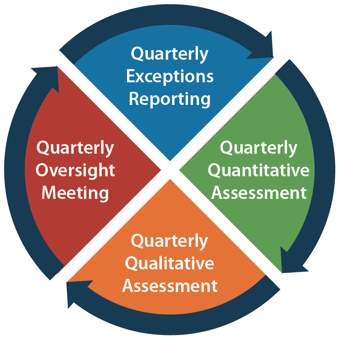
SS&C ALPS Advisors Ongoing Oversight Process for Private Markets FundsOnce a fund has been selected for inclusion, the Research Team performs ongoing due diligence to ensure that the selected funds continue to provide the expected exposures and results. |
|
SS&C ALPS Advisors Investment Due Diligence – Summary
Private markets research and due diligence differs significantly from public markets. Issues such as lack of data transparency, general data availability, data timing and reporting lags, smoothed performance returns and wide dispersions of outcomes must be considered alongside traditional due diligence considerations.
Drawing on decades of private markets research and investing, the SS&C ALPS Advisors Multi-Asset Research Team has purpose-built a process that can assist advisors to make informed private markets allocations to deliver desired investment outcomes.
AAI001116