


Author's note: Except where otherwise noted, the model, examples, and figures in this piece are drawn from Charles I. Jones's 2026 essay "A.I. and Our Economic Future" (NBER Working Paper 34779), which I first encountered as his Stanford Graduate School of Business lecture of the same name.
The debate over artificial intelligence (AI) and the economy has hardened into two distinct camps. One predicts an imminent intelligence explosion that will bend the global growth curve sharply upward. The other sees a foundational technology that, like electricity and the internet, will ultimately settle back into the steady, historical 2% trend we’ve lived with for over a century.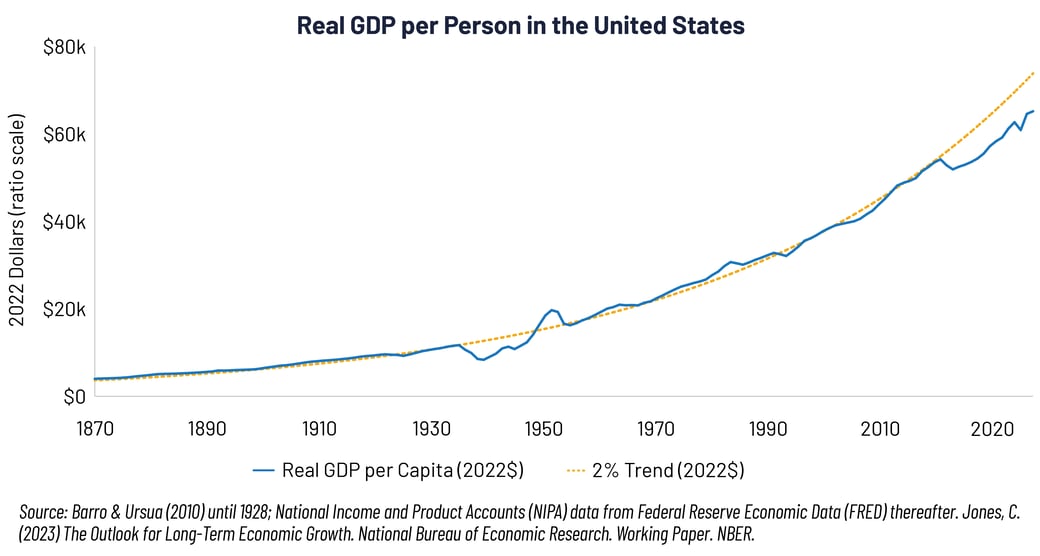 Both arguments are internally coherent, which is why the debate never resolves. A useful contribution from Stanford economist Charles I. Jones1 is a framework showing how both camps can be right, just at different points in time. He calls it the "weak links" model.
A Chain, Not a Rocket
A chain is only as strong as its weakest link, and modern economic value is produced in highly complementary chains. If you take a production process with twenty steps and make seventeen of them instant and free, you may not have moved the needle on overall output. The remaining three unautomated steps now entirely govern the speed of the result.
Jones illustrates this using the device in your pocket. Your phone holds roughly a hundred million times the transistors of the best computers available in the 1970s. Yet, knowledge workers are not a hundred million times more productive. Silicon can invert a matrix at lightning speed, but a human must still decide which hypothesis is worth testing and which categories of numbers belong in the matrix. The scarce human task sets the economic pace.
This shifts the question we should be asking. The bottleneck isn't how capable AI models can become; it is which tasks remain stubbornly unautomated. In a weak-link economy, making one input infinitely abundant yields diminishing returns. If software represents only a tiny sliver of total economic inputs, making software perfect and free doesn't trigger hypergrowth; the rest of the economy simply acts as a drag coefficient. Abundance does not capture value. Scarcity does.
The Bottlenecks You Can Feel
Once you look through this lens, the bottlenecks are visible everywhere capital is currently pointed:
- Electricity: Chips are shipping in volume while the physical substations required to plug them into the grid are not. Large power transformers currently carry lead times stretching past two years.2
- Robotics: A model can pass the bar exam but still cannot reliably fold a towel or turn a patient in a hospital bed. As digital intelligence becomes free, Jones notes that the gripping function of physical hands becomes the premium bottleneck.
- Drug Discovery: AlphaFold3 solved a hard part of the problem, so a candidate molecule can be designed in a fraction of the time it once took. But that molecule must still survive clinical trials in a living biological body, in real-time, for years, in front of a regulator.
Where the Returns Go
Because value migrates to whatever stays scarce, automating a series of tasks rarely destroys an industry, but rather reallocates the economics of the entire bundle.
For example, in 2016, future Nobel Laureate Geoffrey Hinton famously predicted deep learning would eliminate the radiology profession within five years. Instead, there are more radiologists today, earning higher wages. Reading the scan was a commodifiable task, but owning the medical liability, consulting on complex diagnoses, and managing patient anxiety was the actual human bundle. The automated task became cheap while the scarce links became priceless.
Premier financial advice follows a similar trajectory.
Standard portfolio construction, rebalancing and performance reporting are the wealth management equivalent of reading the scan. They are highly analytical, automated, and form the foundational bedrock of a modern practice. But because the proliferation of technology has made these capabilities baseline expectations, they are no longer where an advisory firm can uniquely differentiate.
The true weak links, what we call relationship alpha,4 sit on either side of the software.
The future of differentiation in wealth management belongs to whoever owns these unautomated boundaries. On the front end, it is the advisor who can seamlessly extract what a family is solving for, summon expertise across the entire planning discipline, and coach them through market turbulence. On the back end, it is the operational layer that translates needs and desires into household-level, tax-aware portfolio optimization across dozens of distinct family members and accounts, owning the ultimate execution and accountability when precision is non-negotiable.
Firms that anchor their value to the abundant, strong links may find their fee structures to be less sustainable. The firms that win will ruthlessly automate the strong links, concentrate their financial and human capital into the scarce ones, and own the points in the chain where value accrues. By shifting focus from the abundant links to the scarce ones, elite advisors ensure they aren't just riding the wave of AI abundance but owning the very links that Jones proved will always govern the chain.
Important Disclosures & Definitions

1 Jones, C. I. (2026, June). A.I. and our economic future (Working Paper No. 34779). National Bureau of Economic Research.

2 Patel, S. C. (2026, January 2). Transformers in 2026: Shortage, Scramble, or Self-Inflicted Crisis? POWER Magazine.

3 Lewis, T. (2022, October 31). One of the Biggest Problems in Biology Has Finally Been Solved. Scientific American.

4 Hagmeyer, A. (2023, October 12). Pursuing Relationship Alpha with SS&C Investment Management Services. SS&C Black Diamond.

AAI001189