


As in past industrial revolutions, fixed-income investors will supply most of the capital to build out the technology. This buildout is starting from a fundamentally different place than prior cycles: it has been initially backed by very strong investment-grade issuers across a wide swath of industries. Yet the projected issuance needs are enormous at the same time that the US government's own funding requirements have exploded. Bottlenecks, supply issues, and cost overruns are likely to push spending estimates higher without clarity on how revenues will materialize in the application layers—creating huge winners and losers. We would suggest investing across the entire artificial intelligence (AI) ecosystem stack, not just data centers, and using different tenors and security types to add diversification.
From Cash to External FundingOver the past four years, the Big 5 hyperscalers—Amazon, Microsoft, Google, Meta, and Oracle—funded the initial AI buildout and the model layer primarily through internal operating cash flows. This has changed dramatically recently; their aggregate free cash flow has turned negative, and the shift to external financing began in earnest this year. These companies have issued $225 billion in visible direct bond sales where hardly any existed previously. Meanwhile, “Hidden” or off-balance-sheet debt similar to rent obligations related to data centers that are still under construction, has ballooned to $820 billion.1 But the buildout is global, spans multiple industries, and is still in early innings. By some estimates 75% of the multi-trillion-dollar price tag will be funded with debt.2
The Ecosystem: Not just Data Centers
NVIDIA describes the ecosystem as a “5-layer cake”3 with the application layer—where revenues are ultimately earned—still to be determined. While nobody knows the ultimate spend, estimates for the physical buildout through 2030 range widely. For example, Blackrock has placed the physical ecosystem buildout to be between $5.0 and $8.0 Trillion through 2030.4
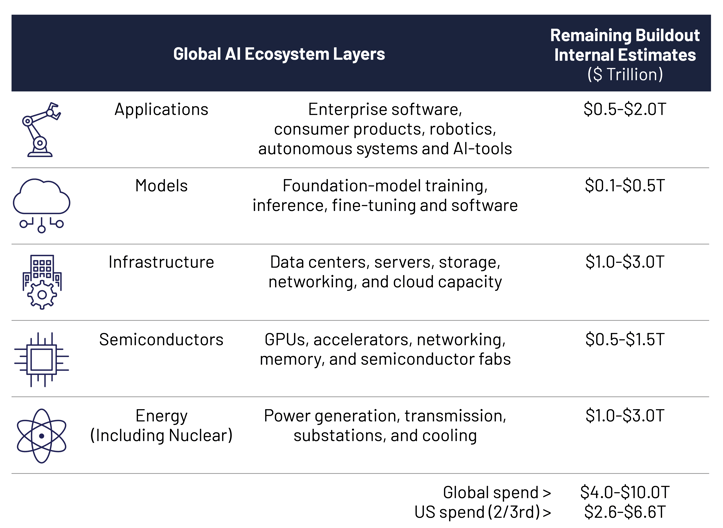
Using the US spend midpoints, if 75% of that is via debt, and 60% of that debt is placed in public markets, the implied new public issuance over the next four years ranges around $2.0 trillion. At this amount, AI-related infrastructure debt would become the single largest component of the corporate bond market. This is a fundamental shift that is occurring in the corporate bond markets at the same time the US Treasury is attempting to refinance $30 trillion of maturing debt in the same window.
Costs and Constraints Rising Faster Than Modeled
Input costs—particularly high-bandwidth memory and advanced packaging—have forced capital expenditures (Capex) revisions upward. Construction delays and skilled labor shortages have emerged as binding constraints. Local backlashes against data centers have delayed or canceled projects in several markets. Utilities are struggling to plan for surging demand without passing on costs to already price-sensitive consumers. In Texas for example, submitted projects are estimated to ultimately require 5x peak energy capacity,5 which recently prompted the governor to declare a moratorium on all new power grid connections for data centers. It is becoming increasingly likely that the foundational energy (power) costs may be the largest constraint to rapid deployment and AI infrastructure costs.
Conclusions
Compared to the internet buildout, which was concentrated in telecommunications and high-yield credit, this buildout is more diverse and led by predominately high-grade issuers—at least for now. However, the bonds are trading more in the BBB range. We anticipate this spread premium to continue as the amount of debt rises, with the dispersion between winners and losers even more acute, and with visibility still low.
For income investors this build-out should provide ample opportunities to increase yields, but a disciplined, holistic approach in our view would represent:
-
Spreading exposure across the entire ecosystem.
-
Overweight shorter-term high yield issuance.
-
Recognize the adjacent infrastructure opportunities are still revealing themselves (e.g. electrical components).
-
Watch for more bondholder-friendly structures to emerge as issuers compete for capital in an increasingly crowded market.
Important Disclosures & Definitions

1 Ma, J. (2026, July 31). After a nearly 1,00% surge, the AI debt orgy can’t last forever, while hidden borrowing has exploded to $1.65 trillion. Fortune.

2 Estrada, S. (2026, June 25). What bubble? JPMorgan says the $5.5 trillion AI capex explosion is profitable—for now. Fortune.

3 Huang, J. (2026, March 10). AI is a Five-Layer Cake. NVIDIA.

4 Kim, T. (2026, April 21). Energy and the AI buildout: An investor’s perspective. BlackRock.

5 Kite, A. and Rowe, J. (2026, August 3). Texas halts power grid connections for new data centers over energy, water supply concerns. Fox 7.

Capital Expenditures (CAPEX/Capex/CapEx): refers to investments in physical assets such as plant and machinery.

AAI001206