


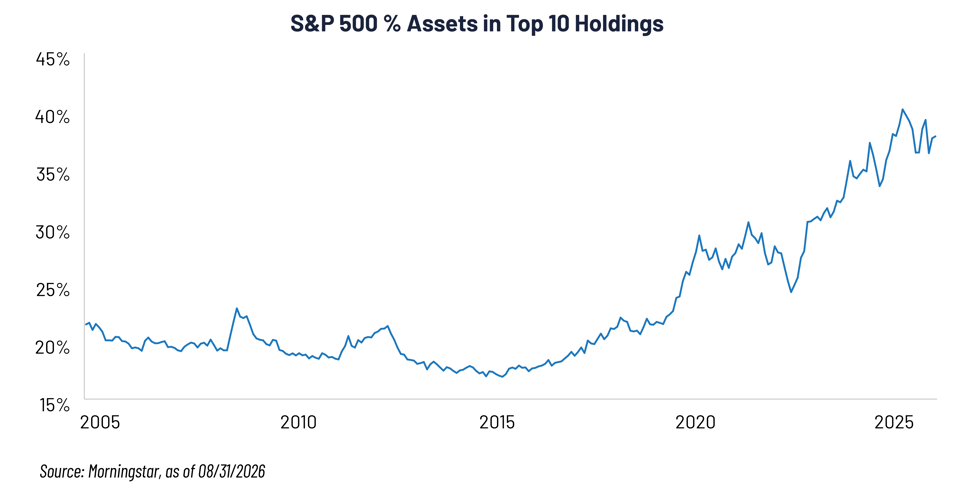
Over the past ten years, the combined weight of the top ten stocks in the S&P 500 Index has increased from just under 20% to almost 40%. Consequently, investors that use market-cap weighted index ETFs are increasingly invested in the largest companies in the United States. Given the increased concentration risk in these types of investments, it may be prudent to consider more diversified, equal weight portfolios.
An equal-weight approach gives each holding the same allocation, reducing dependence on the fortunes of the market’s largest constituents and providing greater exposure to smaller companies within the index.
Equal weighting also introduces systematic discipline: the portfolio periodically rebalances toward its target allocations. This process trims positions that have become relatively expensive or oversized and adds to those that have lagged. While rebalancing does not guarantee superior returns, it creates a consistent framework for buying relatively underperforming holdings and selling relative outperformers.
Historically, equal-weight strategies have often benefited from their broader exposure and a tendency to capture the performance of smaller companies. They may also reduce the risk that a major decline in a few dominant stocks disproportionately affects the entire portfolio.
As with any investment, there are always trade-offs to consider. An equal weight approach, while increasing diversification, may also lead to increased volatility due to the increased exposure to smaller cap stocks, which tend to have greater earnings volatility and may be more cyclical than larger cap counterparts.
On balance, given the current concentration in mega-cap companies, investors may benefit from increased diversification and greater exposure to smaller companies who may be able to grow earnings at higher rates.
Important Disclosures & Definitions

AAI001231