


The Monty Hall problem1 is a classic probability puzzle in which a contestant chooses one of three doors, only one of which conceals a prize.
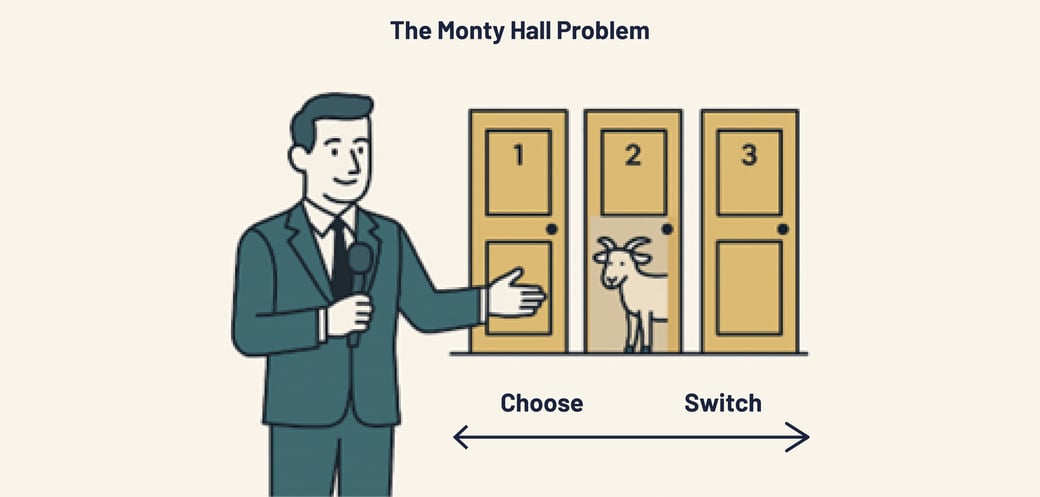
After the choice is made, the host—Monty Hall, who knows what lies behind every door—opens one of the remaining doors to reveal a losing option. The contestant must then decide whether to stay with the original choice or switch. Intuition suggests the odds are now even, but they aren’t; Monty’s constrained action quietly reshapes the probabilities, and switching meaningfully improves the chance of success.
The problem endures because it exposes how easily intuition fails to update when new information or structure enters a decision.
We see versions of this pattern every day in wealth management. Many client decisions unfold as mirrored tradeoffs, yet beneath those seemingly straightforward choices lies a web of constraints: tax concerns, liquidity needs, regulatory changes, market dynamics and the client’s own behavioral biases and heuristics.
These forces silently narrow the set of “true” options or tilt the odds between them. In this analogy, an advisor is not Monty; the advisor is the interpreter who understands how these hidden rules shape the landscape and helps the client see what intuition alone obscures.
Effective advising isn’t about playing probabilities like a game show. It’s about revealing the underlying structure of a client’s financial picture in a way that elevates their intuition. When advisors help clients understand how constraints, behaviors and systems alter the path ahead, the counterintuitive decision often becomes the wise choice. And in that shift—from instinct to informed clarity—the odds of long-term success quietly and meaningfully improve.
Important Disclosures & Definitions

1 The Monty Hall problem is based on the American television game show Let's Make a Deal and named after its original host, Monty Hall. The problem was originally posed in a letter by Steve Selvin to the American Statistician in 1975. It became famous as a question from reader Craig F. Whitaker's letter quoted in (and solved by) Marilyn vos Savant's "Ask Marilyn" column in Parade magazine in 1990.

AAI001043