


“The future ain’t what it used to be” – Yogi Berra
-
Traders and active managers are dusting off the 2022 Russia-Ukraine inflation playbook following the US strikes in Iran.
-
Once again, Treasury Inflation-Protected Securities (TIPS) serve as an early market indicator of real rates and how investors are repricing inflation expectations.
-
This oil shock, however, arrives in a far different environment for the economy, policymakers and investors—and is likely to play out differently than the post-pandemic, demand-driven inflation surge of 2022.
-
These are the moments when active management has historically excelled, taking advantage of market dislocation and pricing inefficiencies that often arise in periods of volatility and uncertainty.
And a reminder: TIPS are inflation-protected, not inflation-hedged—a distinction that often gets overlooked.
What Are TIPs Telling Us?
Indications of the real rate of interest and inflation expectations appear in the breakeven rates of short-term TIPS. These securities adjust their principal amounts based on changes in Consumer Price Index (CPI) and their breakeven rate—the yield spread between TIPs and the nominal interest rate on Treasuries—that represents the market’s estimate of average inflation over the period.
Comparing the 2022 Ukraine invasion with the 2026 Iran strikes shows a familiar pattern: short-term inflation expectations rise in step with oil prices. The current move is shallower but still trending higher as the chart below illustrates: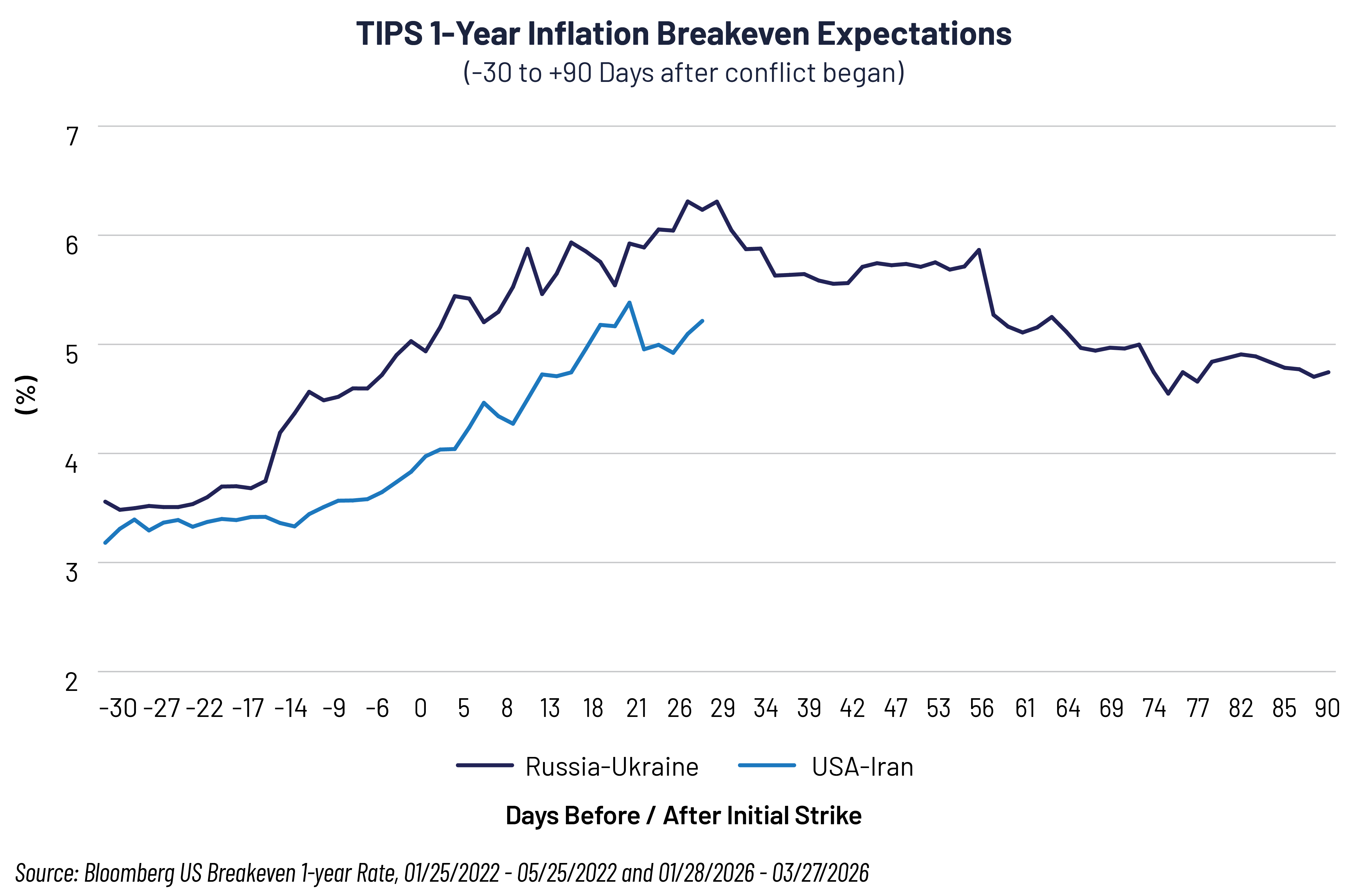 The chart illustrates that at current 1-yr breakeven rates, realized inflation would need to average about 5.3% for the period—for example, climbing from the current 2.4% to 8.4% by the end of the period. While oil is a small 6% component of the CPI, its impact on other prices is significant. The International Monetary Fund (IMF) estimates that every 10% increase in oil results in a 40-basis point (bps) increase in inflation. Using the above scenario, oil prices would need to average about $165/per barrel in the period (see footnotes for assumptions).1
The Fed’s Different Starting Point
In 2022, the Fed reacted quickly and aggressively to the Ukraine-related oil spike, hiking rates at every subsequent meeting until May 2023. In hindsight, this was arguably too late—policy rates were near zero and inflation was already near 8% at the time of the strike. The surge in oil prices was the catalyst that broke the Federal Reserve’s (Fed) “transitory” inflation narrative. But by year-end, CPI was decisively trending lower and inflation expectations normalized.
Today, the Fed starts from a tighter stance with this oil spike. With the funds rate at 3.75%—which is likely neutral to restrictive—together with signs of economic softness already visible, particularly in employment. The next Fed meeting is on April 26th and the Fed will get only a week or so of actual impact inflation data, but one key data point will be the March CPI on April 10th. Currently futures markets assign less than a 10% probability of a rate hike at this meeting, consistent with the view that the Fed will wait to see more durable evidence of spillover into core inflation.
Bond Market Reaction
In 2022, yields initially rose very little following the invasion—until the Fed began its aggressive hiking cycle that later produced the worst year on record for Core Bonds. This time, yields have reacted more sharply at the outset, perhaps as expectations before the Iran event were skewed toward a near-term rate cut. Still, recent weakness at the long end of the maturity curve should be a concern for policymakers in any future decisions. Longer-term embedded inflation expectations or lack of credibility in reducing inflation are chief concerns for this portion of the bond market.
| CHANGE IN TREASURY YIELDS TWO WEEKS AFTER ATTACK EVENTS (BASIS POINTS) | ||||
| 2 Year | 5 Year | 10 Year | 30 Year | |
| 2022 - UKRAINE | 11 | 6 | 3 | 9 |
| 2026 - IRAN | 27 | 31 | 29 | 27 |
Economic Backdrop: Then vs. Now
While oil shocks are initially viewed as inflationary, history shows they can also trigger recessions and deflation if they are deep or prolonged. Starting points matter in this regard. In 2022, the economy was emerging from a short but severe recession with abundant liquidity and robust demand. In 2026, growth looks more uneven; still solid at the aggregate level but distinctly K-shaped, with some consumer segments and businesses showing year-over-year weakness.
Note: It should be noted that the impact on Producer Price Index (PPI) is much more onerous, where the index weighting is 17% versus 6% for the CPI. Because not all prices can be passed through to consumers, this means the oil spike is typically borne by businesses disproportionately.
As a result, demand destruction could take hold more quickly in this environment given a weakened consumer cohort. Large federal borrowing needs may also test the Treasury’s capacity to issued debt without pushing up long-term yield further. Also, the Treasury’s issuance of TIPS does not reduce interest payments in periods of inflation as they are indexed to inflation. Due to demand and issuance trends, they now comprise about 7% of total debt.
| METRIC | 2022 | 2026 |
| 10-YEAR TREASURY YIELD | 2.00% | 4.50% |
| FED FUNDS STARTING RATE |
0.25% | 3.75% |
| CONSUMER SPENDING (YOY,PCE) | 14.16% | 5.25% |
| BUSINESS CAPITAL SPENDING (YOY) | 14.33% | 3.92% |
| UNEMPLOYMENT | 3.90% | 4.40% |
| STARTING CPI INFLATION | 7.94% | 2.43% |
| U.S. GOVERNMENT DEBT ($T) | $30.4 T | $38.5 T |
Conclusion
As Yogi Berra also said, “It’s tough to make predictions, especially about the future.” It is too early to predict whether this oil shock will produce a replay like the fixed-income destruction in 2022—but it seems less likely to match it given the starting yield points and economic backdrop. Still, inflation protection and “stagflation” positioning remain relevant—favoring defensive, value and quality factors in fixed income.
If ultimately the growth shock proves severe, the Fed may get cover to cut rates. Until then, expect elevated volatility, tighter credit and a more challenging backdrop for borrowers—conditions historically favorable for active managers. For long-term investors, this environment also offers opportunity: the chance to lock in higher yields, move up in quality without sacrificing income and rebalance equity-heavy portfolios.
A Final Word on TIPs
-
TIPS make the most sense when CPI is below breakeven rates—not above, as it is now for very short-term TIPS. Slightly longer maturities, like 5-year TIPs (breakevens less than 3%), may offer better value for investors expecting a structural inflation shift.
-
TIPS are inflation-protected, not inflation-hedged. Investors lost money on TIPS in 2022 along with other Treasury investors that sold prior to stated maturity. Non-fixed income sectors may offer more attractive longer-term inflation hedging.
-
TIPS are taxable. Because principal inflation adjustments are treated as taxable income—even though the cash is not paid until maturity—they are best suited to IRAs or other tax-advantaged accounts where maintaining purchasing power is a key goal.
Important Disclosures & Definitions

1 International Monetary Fund estimate of oil/CPI impact.  March 9, 2026. Our assumptions for the calculation assume inflation rises to 5.3% on average for the 1-yr period. Oil price is assumed to start the period at $95. The CPI 74% increase in oil is then applied with the Oil CPI multiplier of 40 bps = 2.9% increase in CPI. Current CPI is 2.4%+2.9% increase = 5.3%

Basis Point (bps): a unit that is equal to 1/100th of 1% and is used to denote the change in a financial instrument.

Bloomberg US Breakeven 1-year Rate: the rate is derived by calculating the difference between the 1-year nominal Treasury yield and the 1-year TIPS yield, representing the market's expectation of average inflation over that period.

Consumer Price Index (CPI): a measure of the average change over time in the prices paid by urban consumers for a representative basket of consumer goods and services.

Producer Price Index (PPI): a measure of the average change over time in the selling prices received by domestic producers for their output.

One may not invest directly in an index.

AAI001135