


Many of our clients oversee accounts for investors that hold concentrated, embedded-gain positions in the Mega-Cap Artificial Intelligence (AI) complex and utilize direct indexing as an appropriate vehicle for managed diversification over time. The standard practice constructs a completion sleeve that tracks a broad benchmark, ex-concentration, and harvests losses where they arise. We argue that the standard practice leaves significant value uncaptured in the current market regime.
Inside the Correlation Matrix
Equities of Health Care and Consumer Staples businesses have moved in near-mirror opposition to the AI complex on a relative return basis over the trailing 18 months, with cross-sector correlation approaching −0.8. Historically, these sector pairs have hovered near zero. The current regime reflects an identifiable flow-of-funds mechanism: hyperscaler capital expenditures absorb marginal investor allocation, defensive sectors are funded residually, and the resulting price action is mechanically anti-correlated. For clients with concentrated AI exposure, this is information sitting inside the correlation matrix that benchmark-neutral completion sleeves may not exploit, leaving higher after-tax and net-of-fees returns on the table.
Tilting the completion sleeve toward Health Care and Consumer Staples within a disciplined tracking-error budget produces two compounding effects at the household level. First, total portfolio variance falls more rapidly than tracking error rises, because the cross-covariance term dominates own-variance contributions when the correlation is meaningfully negative. Second, the realized loss inventory becomes structurally aligned with the client's tax-management needs: the defensive sleeve generates harvestable losses precisely when the concentrated position is generating new gains pressure, rather than randomly across the calendar.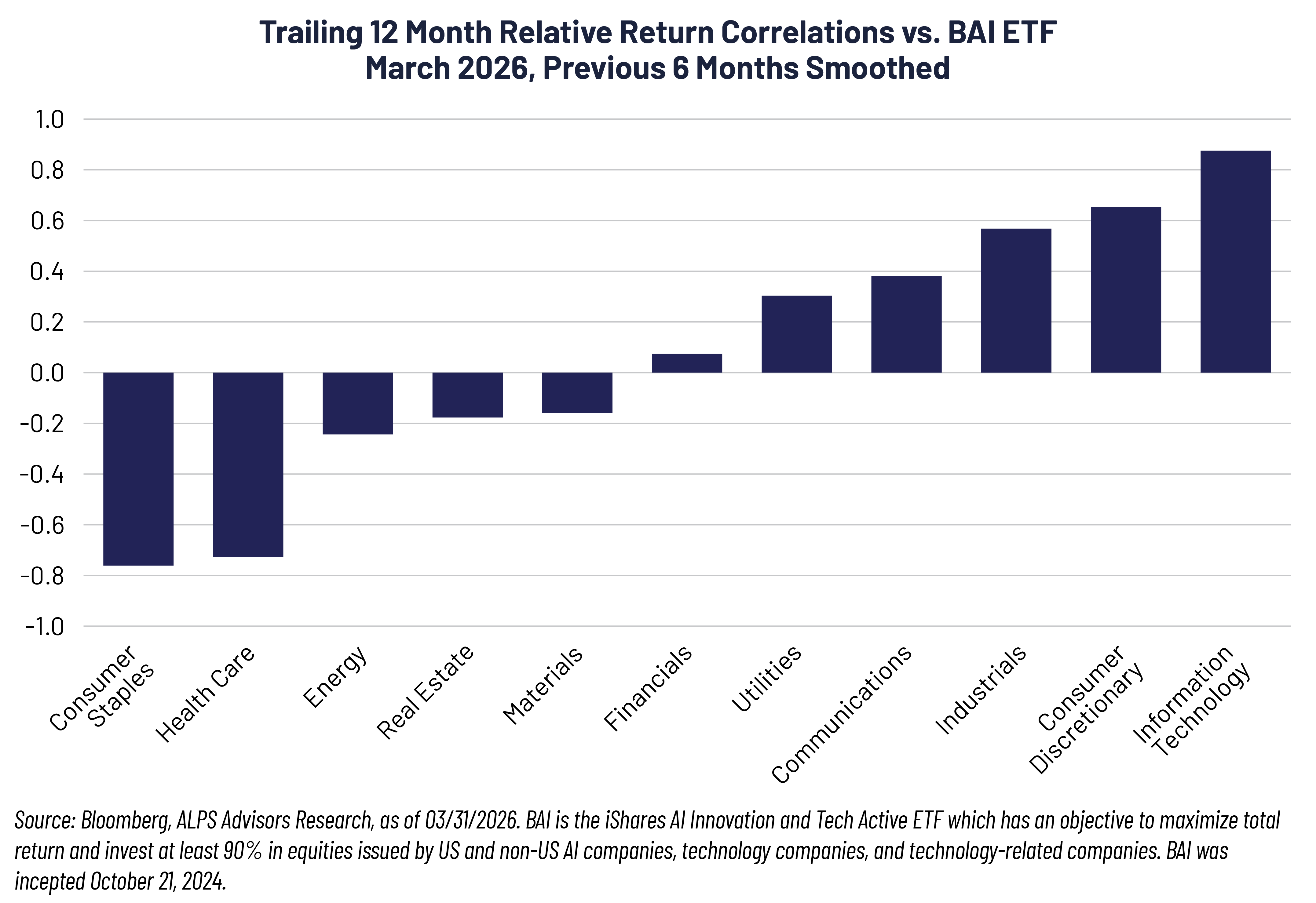 The Long-Only 130/30
For clients running both a tax-aware direct indexing (DI) engagement and a separately funded 130/30 active-extension mandate, the comparison is instructive. A portion of the factor offset that long-short mandates deliver explicitly, at fees of 80 to 150 basis points (bps) with additional borrow costs, leverage friction, and ordinary-income tax treatment on rebates, may already be available implicitly inside a thoughtfully constructed completion portfolio at fees of 15 to 25 bps. The implication is not that one product replaces the other, but that an audit of total factor exposure across the household is warranted to ensure the fees being paid are funding distinct work.
The practical construction is a constrained optimization targeting tracking error to the broad benchmark, subject to gains realization constraints, a sector-tilt budget toward Health Care and Consumer Staples, and factor-neutrality elsewhere. The tilt should be sized as a tactical overlay rather than a permanent benchmark adjustment, with quarterly review tied to the rolling correlation between the AI complex and defensive sectors and to aggregate hyperscaler capital spending guidance. When the correlation reverts toward historical norms, the rationale weakens and the completion sleeve should revert toward benchmark-neutrality.
The Completion Portfolio is the Product
Direct indexing is most often positioned as a passive investing tax-management tool. That framing understates the product. In any given market regime, the correlation matrix carries information about completion portfolio construction that a simple benchmark-neutral approach discards. The current regime, which can be described as concentrated AI wealth on one side and defensive sectors absorbing the residual flow on the other, happens to make that information unusually valuable. The completion portfolio is not a passive remainder of the optimization but rather where the real work happens.
Important Disclosures & Definitions

Basis Point (bps): a unit that is equal to 1/100th of 1% and is used to denote the change in a financial instrument.

Direct Indexing (DI): is a strategy where investors purchase individual stocks within an index to mimic its performance.

Trailing 12 Months (TTM): is a tool used to evaluate a company's financial health over the most recent 12-month period, capturing trends that might differ from annual reports.

AAI001155