


"Sometimes that thing you're searching for your whole life, it's right there by your side all along. You don't even know it."

— Yondu Udonta, Guardians of the Galaxy Vol. 2
The artificial intelligence (AI)-driven rapid destruction of enterprise Software as a Service (SaaS) valuations, the private credit fallout, ongoing geopolitical conflicts, and rising inflation expectations have sent investors searching for more durable sources of returns—assets with predictable cash flows that can better withstand inflation and rapid technological change.
Features Have Become Bugs
It turns out many asset-light, intellectual property-based businesses are vulnerable to disruption. AI is exceptionally good at generating code, documents, and automating high-value knowledge-worker tasks—exactly the high-margin activities these companies depend on. When a company’s core competitive advantage can be replaced with a few chat prompts, market participants are quick to sell a company when there is a threat to long-term viability.
AI’s insatiable demand for power and related services has put a new spotlight on decades of underinvestment, as both governments and companies have delayed critical spending on energy grids, pipelines, mines, factories, and communications and transportation networks—a void that McKinsey has estimated to be $106 trillion.1 This structural shortfall, colliding with surging AI-driven demand, is pushing capital expenditures higher after years of neglect.
AI has turned the asset-light “features” of software and di minimis infrastructure investments into “bugs”.
HALO: Hard Asset, Low Obsolescence
Enter HALO, a term coined by Josh Brown2 and institutionalized by Goldman Sachs.3 HALO companies are those which provide products and services backed by tangible, long-lived physical assets such as pipelines, power grids, factories, heavy equipment, railways, and telecom networks. They can generate significant cash for decades with limited risk of technological obsolescence.
HALO assets combine high capital intensity with long economic lives. They tend to produce predictable cash flows, benefit from inflation pass-through mechanisms (regulated rates, long-term contracts, or commodity pricing), and face high barriers to new competition. Unlike many software or asset-light businesses, these are real things that the economy cannot function without—and ironically AI is now making more valuable.
The table below lists examples of companies that have been cited by investment analysts and research reports as companies with HALO attributes, which include energy, equipment, transportation, industrials, consumer discretionary, consumer staples, and utilities sectors.
| Ticker | Company Name | Sector | HALO Criteria |
| XOM | ExxonMobil | Energy | Heavy physical assets (refineries, rigs); AI cannot replace underlying energy demand. |
| COP | ConocoPhillips | Energy | Heavy physical assets (refineries, rigs); AI cannot replace underlying energy demand. |
| CAT | Caterpillar | Industrials | Long-lived equipment & factories; physical production assets. |
| DE | Deere & Co | Industrials | Heavy machinery & factories; essential physical infrastructure. |
| UNP | Union Pacific | Industrials | Long-lived rail networks & physical transport assets. |
| FDX | FedEx | Industrials | Physical delivery networks & fleet assets. |
| LOAR | Loar Holdings | Industrials | Niche physical components in defense. |
| MCD | McDonald’s | Consumer Discretionary | Massive physical footprint of restaurants & supply chain. |
| KO | Coca-Cola | Consumer Staples | Physical bottling plants & distribution infrastructure. |
| NEE | NextEra Energy | Utilities | Power grids & renewable infrastructure (long-lived regulated assets). |
| CEG | Constellation Energy | Utilities | Physical power plants serving AI data centers. |
| ETN | Eaton | Industrials | Physical electrical infrastructure & data-center equipment. |
| VRT | Vertiv | Industrials | Physical cooling systems for AI infrastructure (heavy asset play). |
| CARR | Carrier Global | Industrials | Physical HVAC equipment & infrastructure. |
Sources: La Monica, P. (2026, February 24). The Anti-AI Trade Is Red Hot. These Stocks Are the Winners. Barron's.
Henderson, R. (2026, February 24). Goldman Team Says Asset-Heavy Stocks Outperform on AI Fears. Bloomberg.
Yahoo Finance & Motley Fool. (2025–2026). Multiple articles citing HALO investment examples. Yahoo Finance; The Motley Fool.
Note: Provided only as examples, not investment advice.
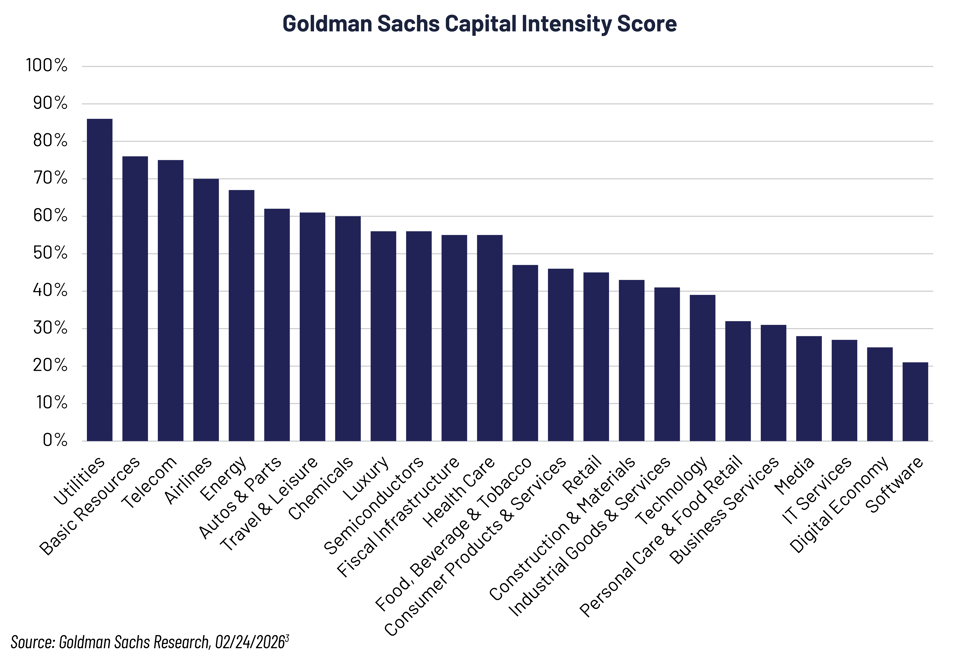
In a recent study,3 Goldman Sachs quantified HALO companies and sectors by assigning a Capital Intensity Score using six metrics that captured a company’s dependence on physical capital rather than human or intangible inputs. Not unexpectedly, Utilities, Basic Resources, and Telecom sectors had high Capital Intensity Scores, while IT Services, Digital Economy, and Software measured far lower scores.
 HALO: Factor, Sector, or Theme?
HALO has investment appeal, but there is some uncertainty around how to identify and classify companies and make allocations.
Many thematic funds and strategies now marketed as “HALO-like” (i.e., electrification, smart grid, wide-moat compounders, and quality industrials) vary widely in focus and construction. As a result, building a HALO allocation requires thoughtful customization rather than a simple one-click solution.
For some, HALO could mean public equities in sectors such as consumer staples, industrials, transportation, and energy that have high asset intensity. HALO exposure can often resemble traditional value stocks, which brings both opportunity and risk. Like value investing, it can include attractively priced businesses with durable assets but also potential value traps. Importantly, because most HALO holdings are equities, they can still move with broader market direction during major selloffs.
For others, it could extend to public Real Estate Investment Trusts (REITs) and private real estate. Real estate categories such as industrial warehouses, telecommunication towers, and data centers provide strong cash flows, are difficult to duplicate, and provide critical infrastructure services that facilitate modern life.
Public and private infrastructure could also be considered HALO, as toll roads, bridges, ports, and grid infrastructure are often financed and operated by infrastructure companies. These are long-life, difficult to replicate assets, with built-in inflation adjustments in their fee schedules. With a backlog of $106 trillion in potential projects, global demand appears to be robust.1
Allocations
The massive AI disruption, coupled with decades of underinvestment capital assets and infrastructure, has created a potentially historic opportunity for allocators to reconsider the merits of heavy asset companies and related asset classes.
Perhaps the real insight is that HALO has been with us for decades. The AI era has simply given a new name to one of investing’s oldest and most reliable truths.
Like Yondu said, sometimes what you’ve been searching for has been right there all along.
Important Disclosures & Definitions

1 Green, A., Nangia, I., Sandri, N. (2025, September). The Infrastructure Moment: Investing in the Expanding Foundations of Modern Society. McKinsey and Company.

2 Brown, Josh. (2026, February 8). The Most Important Investing Theme of 2026 is HALO. Downtown Josh Brown.

3 Jaisson, G., Oppenheimer, P., Bell, S., Ferrannini, G. (2026, February 24). The HALO Effect: Heavy Assets, Low Obsolescence in the AI era. Goldman Sachs Research.

AAI001144