


- A fragile two-week ceasefire between the US and Iran has sent oil prices plunging below $95 and equities surging.
- Rising intra-index correlations in the S&P 500 Index signal that macro risk remains the dominant driver of stock prices, compressing the diversification benefit of a traditional equity portfolio.
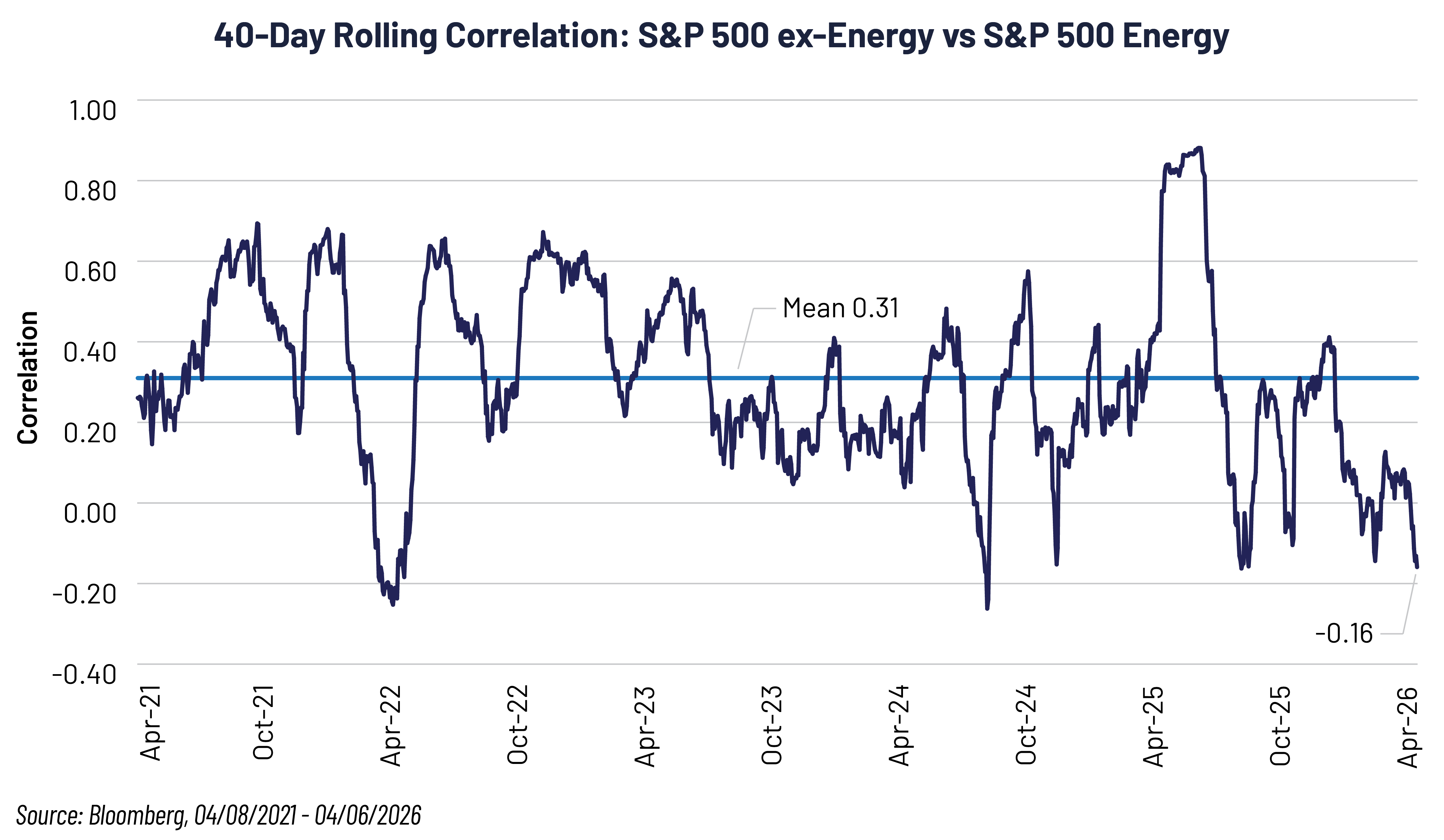
- The 40-day rolling correlation between the S&P 500 Ex-Energy and the S&P 500 Energy Sector Indexes has turned decisively negative, suggesting Energy is functioning as a portfolio hedge rather than a correlated risk asset.
- The unprecedented depletion of global strategic petroleum reserves—over 400 million barrels released from the International Energy Agency (IEA) stockpiles alone—creates a medium-term structural bid under energy prices as nations compete to refill depleted inventories, establishing a higher floor regardless of ceasefire outcomes.
Late Tuesday evening, April 7th, less than two hours before his self-imposed deadline to destroy Iranian civilian infrastructure, President Trump announced a two-week ceasefire brokered by Pakistan. Iran’s foreign minister confirmed Tehran would allow coordinated passage through the Strait of Hormuz for the duration. WTI crude immediately plunged over 16% to roughly $94 per barrel, S&P 500 futures surged nearly 3%, and markets exhaled. But this is a pause, not a resolution—and for equity investors, the correlation data collected over the past five weeks reveals structural shifts that a two-week truce does not unwind.
The 1-month realized correlation of S&P 500 Index constituents surged from roughly 0.08 in late February to 0.33 as of April 7th, a fourfold increase in just over a month. When correlations rise this sharply, individual stock selection matters less and macro positioning matters more. The market has been moving as a single organism—risk on, risk off—and the traditional diversification embedded in a broad index portfolio has eroded rapidly. For context, the last time realized correlations were this elevated was during the post-Liberation Day volatility in April 2025, when the index briefly touched 0.67. We are not there yet, but the trajectory was unambiguous heading into the ceasefire—and a two-week pause in hostilities does not reset the geopolitical uncertainty that drove correlations higher in the first place.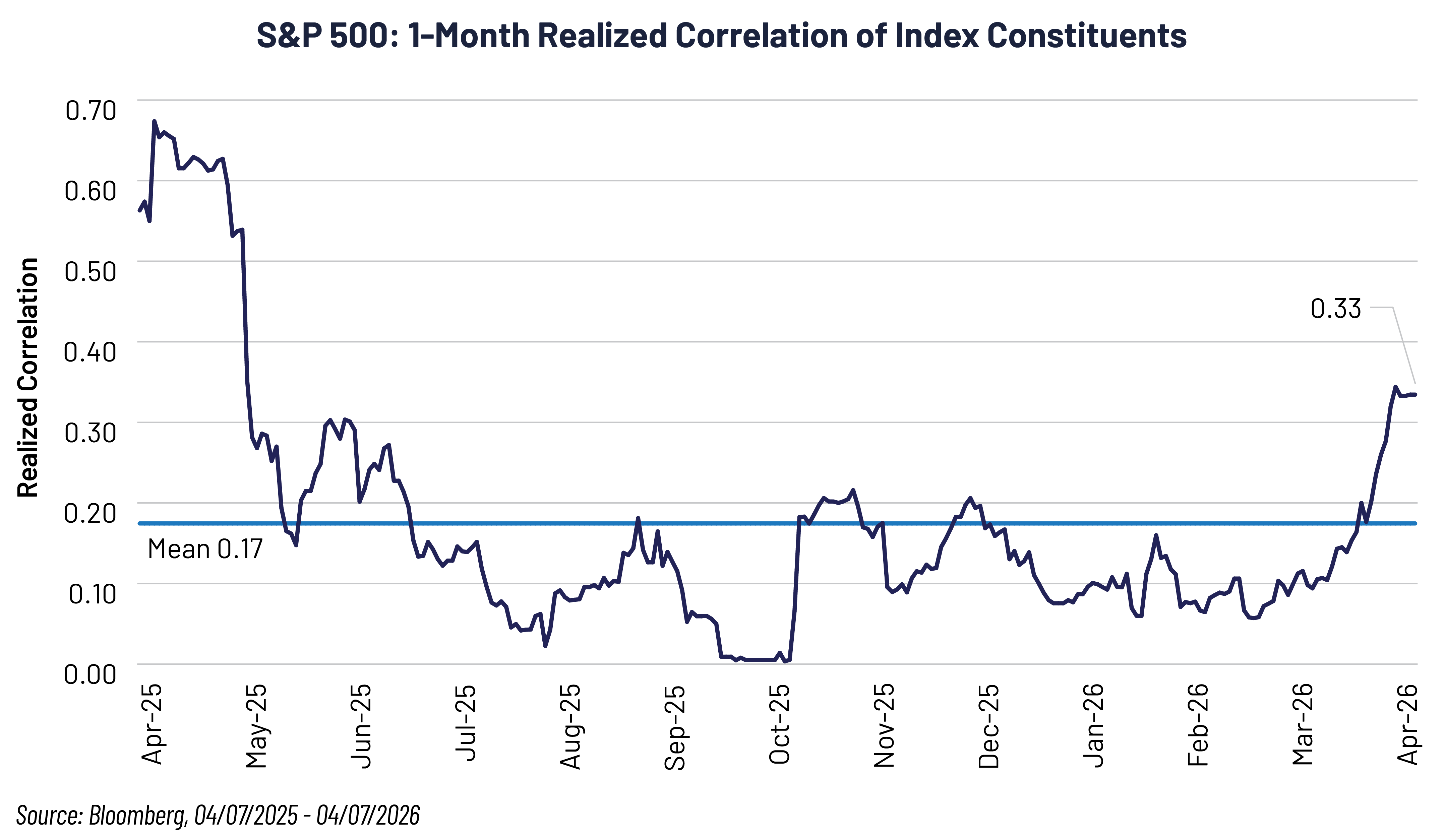 More revealing is the 40-day rolling correlation between the S&P 500 ex-Energy Index and the S&P 500 Energy Sector Index, which plunged to -0.16 heading into the ceasefire—deeply negative for the first time since early 2021. In plain terms, Energy has been moving inversely to the rest of the market. When the S&P 500 ex-Energy sold off on stagflation fears, supply chain disruptions, or the cascading effects of higher gasoline prices, Energy rallied—and vice versa. Tuesday night’s price action was a textbook illustration: oil dropped 16%, equities surged 3%, and the negative correlation expressed itself in real time. This relationship does not vanish because a ceasefire was announced—it persists for as long as geopolitical uncertainty remains the dominant variable, and with Islamabad peace talks scheduled under conditions both sides have described as fragile, uncertainty is in ample supply.
 Even in a scenario where the ceasefire holds and eventually produces a durable peace between countries, the energy market is structurally different than it was on February 27th. The IEA coordinated the largest emergency stockpile release in its 52-year history; 400 million barrels across 32 member nations, with the US alone committing 172 million barrels from a Strategic Petroleum Reserve (SPR) that had only recently been rebuilt to 415 million barrels. That SPR will exit this crisis at roughly 243 million barrels, its lowest level ever, and must be refilled. Japan, Germany, France, and South Korea face similar mandates. The US Department of Energy (DOE) has already structured exchange agreements requiring companies to return borrowed barrels with a premium, and Energy Secretary Chris Wright has committed to replacing 200 million barrels within the next year. This is a contractually obligated demand source that establishes a medium-term bid under crude prices irrespective of geopolitics. Nations do not deplete a third of their strategic reserves without aggressively replenishing them, and that replenishment competes with normal commercial demand for available supply.
The conflict has also permanently repriced geopolitical risk in energy assets. Iran demonstrated that it can close the Strait of Hormuz—removing 20% of global seaborne oil—and withstand five weeks of US-Israeli military operations before agreeing to talks. Lloyd’s of London has signaled that maritime insurance premiums are unlikely to normalize until a permanent treaty is signed, and Iran’s insistence on coordinating Strait passage through its armed forces introduces a de facto toll on the world’s most critical energy chokepoint.
While the ceasefire’s fragility cannot be minimized, a durable peace could normalize correlations, compress the war premium in crude, and shift the Energy trade from a hedge back to a cyclical allocation. The distribution of outcomes remains exceptionally wide.
For investors, the takeaway is that Energy’s hedging properties are now undeniable, offering uncorrelated returns apart from fixed income and the broader equity complex. The S&P 500 Energy sector delivered a 38%+ return in Q1 while the broad index fell approximately 5%; that performance gap was not an anomaly but rather the expression of a new correlation regime born from conflict. Whether that regime persists depends on events unfolding in Islamabad peace talks—but the option value of maintaining Energy exposure in a world where Hormuz can be closed in a day is now impossible to ignore.
Important Disclosures & Definitions

Correlation: a statistic that measures the degree to which two variables move in relation to each other.

S&P 500 Energy Sector Index: a capitalization-weighted index designed to replicate performance of the Energy Sector of the S&P 500.

The S&P 500 Ex-Energy Index: is designed to measure the broad U.S. market, excluding members of the GICS® Energy sector.

S&P 500 Index: widely regarded as the best single gauge of large-cap US equities. The index includes 500 leading companies and covers approximately 80% of available market capitalization.

One may not invest directly in an index.

AAI001138